6.4 Trigonometry and Vectors
What is a vector?
A vector in the plane is a directed line segment (represented by an arrow) from some initial point \(P\) to some terminal point \(Q\).
Two vectors are considered equivalent if they have the same magnitude and the same direction.
When the initial and terminal points are named with letters such as \(P\) and \(Q\), the vector can be represented as \(PQ\) with an arrow over the top, i. e. vector \(\overrightarrow{PQ}\). When we do not name the initial and terminal points, we may use a single letter, such as \(u,v\) or \(w\) to denote a vector. Sometimes an arrow is placed over these as well, or they may be written in a bold font. In this tutorial we will do neither of these and will just use an italic font.
A standard vector is a vector in standard position, which means a vector with initial point at the origin in the Cartesian coordinate system. Every vector in the plane is equivalent to a standard vector.
Displacement is an example of a quantity measured by a vector.
Suppose an object in a plane (the floor, for example) is moved three units to the east and four unit north.
Then it would have been displaced a total of five units in an approximately north easterly direction along the diagonal of a right triangle with sides three and four.
In the science of Physics, force is a quantity measured by a vector. Every force has a magnitude and a direction of application. The 'length' of a force vector equals the magnitude of the force.
Addition of vectors
Consider how one would 'add' two displacements.
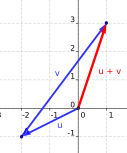
Suppose an object is moved 2 units west, then one unit south. We represent this displacement with vector \(u\).
Next, the object is moved 3 units east and 4 units north. We represent this displacement with vector \(v\).
The sum or result of the two displacements would be the same as if the object had been moved 1 unit east and 3 units north. This displacement is represented as the sum of the two vectors \(u+v\).
Picture the first displacement as an arrow going from the initial position of the object to its next position
.Then think of the second displacement as an arrow going from the second position of the object to the third position.
Then the resulting displacement would be an arrow going from the first position of the object to the third position of the object.
See the diagram:
Components of a vector
We see that the addition of vectors can be represented by placing the initial point of the second vector at the terminal point of the first vector, then the sum of the two vectors is the vector beginning at the initial point of the first vector and ending at the terminal point of the second vector.
This is sometimes called the triangle rule for the addition of vectors. Using this same example, we can introduce the idea of the components of a vector.
Vector components are sometimes indicated by an ordered pair of numbers between two 'angle brackets'.
Thus, the first displacement in this example--two units west and one unit south--could be represented by the components \(\langle -2, -1 \rangle\).
The second displacement--three units east and four units north--could be represented by the components \(\langle 3, 4 \rangle\).
Notice that it is easy to find the components of the sum or resultant vector--just add the components of the vectors. \(\langle -2, -1 \rangle + \langle 3, 4 \rangle = \langle -2+3,-1+4\rangle=\langle 1, 3 \rangle\).
The magnitude and direction of a vector
Now, consider a standard vector \(v = \langle a, b \rangle\).
The length or magnitude of of \(v\) is denoted by \(| v |\) and computed using the Pythagorean Theorem.
\(|v|=\sqrt{a^2+b^2}\)
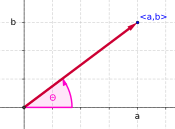
Notice that \(\dfrac{a}{| v |} = \cos\theta\) and \(\dfrac{b}{| v |} = \sin\theta\) , where \(\theta\) is the angle between \(v\) and the positive \(x\)-axis.
So \(v = \langle a, b \rangle = \langle | v | \cos \theta , | v | \sin\theta \rangle = | v | \langle \cos \theta , \sin \theta \rangle\).
That is, \( v = | v | \langle \cos \theta ,\sin \theta \rangle\).
The vector \(\langle \cos \theta , \sin \theta \rangle\) is called the direction of the vector \(v\).
This means that a vector equals the product of its magnitude and its direction.
Notice that we factored out the constant \(| v |\) from the components of the vector. In the context of vectors, constants are referred to as scalars.
We can factor a scalar out of a vector because multiplying a vector by a scalar changes the length of the vector accordingly.
If we multiply a vector by \(2\), the length is doubled and the direction is unchanged.
If we multiply a vector by one-half, the length is halved and the direction is unchanged.
However, if we multiply by \(- 1\), the length is unchanged and the direction is reversed.
Factoring is just the inverse of multiplying. It is division viewed from an alternate perspective.
In general, if \(v = \langle a, b \rangle\), then \(c v = c\langle a,b \rangle = \langle c a, c b \rangle\)
Viewed from left to right, this equation illustrates how to multiply a vector by a scalar.
But viewed from right to left, \( \langle c a, c b \rangle = c\langle a,b \rangle = cv\) it shows how to factor a scalar from a vector.
Exercise 6.4.1
Find the magnitude of the direction vector \(\langle \cos\theta , \sin\theta \rangle\).
See SolutionUnit vectors
The definition of a unit vector is "a vector of length one." But this is just the same as a direction vector.
"Direction vector" and "unit vector" are terms referring to the same concept.
When we use the term "direction vector" we are more concerned with \(\theta\), the direction angle of the vector--the angle it makes with the positive \(x\)-axis.
When we use the term "unit vector" we are more concerned with magnitude than with direction.
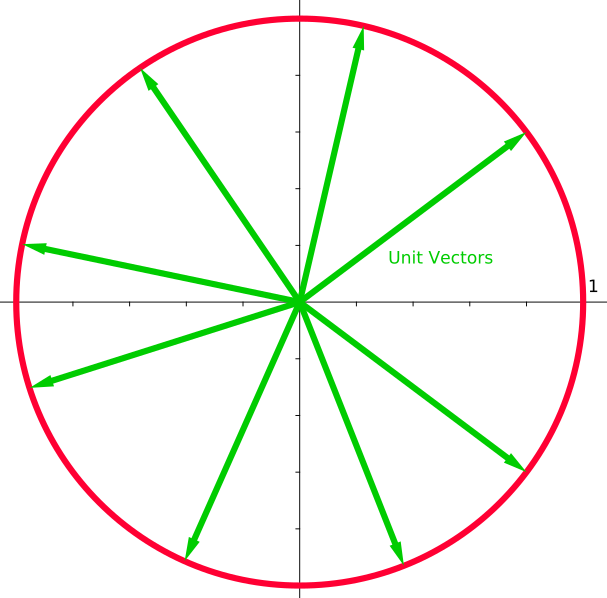
If all unit vectors are placed in standard position with their initial point at the origin, then their terminal points will all lie on the unit circle.
Exercise 6.4.2
Given that \( v = \langle -2, 2 \rangle\), find the magnitude, the direction angle \(\theta\) and the direction vector.
Find the components of \(3 v\), and \(-2 v\).
See SolutionThe basis vectors \(\mathbf{i}\) and \(\mathbf{j}\)
Two special unit vectors are sometimes defined:
\(\mathbf{i} = \langle 1, 0 \rangle\) corresponding to the direction angle \(0^\circ\) and \(\mathbf{j} = \langle 0, 1 \rangle\) corresponding to the direction angle \(90^\circ\).
Every vector in the plane can be represented as a linear combination of the unit vectors \(\mathbf{i}\) and \(\mathbf{j}\).
"Linear combination" means "a sum of scalar multiples".
\(\langle a, b \rangle = \langle a, 0 \rangle + \langle 0, b \rangle = a \langle 1, 0 \rangle + b \langle 0, 1 \rangle = a \mathbf{i} + b \mathbf{j}\)
Thus, \(a \mathbf{i} + b \mathbf{j}\) is an alternate way of writing the vector \(\langle a, b \rangle\) in component form without using angle brackets.
.Exercise 6.4.3
Find the components of a vector of magnitude \(4\) and direction angle \(45^\circ\).
See SolutionFinding a resultant vector
The resultant of two vectors is just their sum.
The term "resultant" is usually used in a "coordinate-free" context. By "coordinate-free" is meant, there is no specific coordinate system specified and the vectors are given in terms of their magnitudes and "relative" directions with respect to each other. Typically, the angle between the two vectors may be all the information given about their directions.
To find the sum, or resultant vector of two vectors given only their magnitudes and the angle between them, one must use the Law of Cosines.
Consider the following problem:
Two vectors \(u\) and \(v\) of magnitude of \(5\) and \(2\) respectively are separated by an angle of \(30^\circ\).
Find the magnitude of the resultant vector \(u + v\) and the angle the sum makes with the first vector.
Note that in a coordinate free context, any angle must be with respect to one of the given vectors.
The following is a geometrical diagram of the problem:
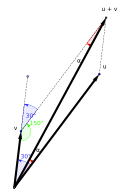
The vectors \(u\) and \(v\) are initially drawn from the same initial point so that we can show the \(30^\circ\) separation. A copy of \(u\) is then moved so that it begins at the terminal point of \(v\). This new copy of \(u\) makes an angle of \(180^\circ - 30^\circ = 150^\circ\) with \(v\). This gives us a triangle with sides \(2\) and \(5\) and an included angle of 150^\circ\). Thus, we can find the magnitude of \(u + v\) using the Law of Cosines.
\(| u + v |^2 = 5^2 + 2^2 - 2 ( 5 ) ( 2 ) \cos 150^\circ = 29 - 20\cos150^\circ\approx 46.3205\).
So \(| u + v |\approx 6.806\).
To find the angle \(\alpha\) the sum makes with \(u\), note that it is congruent to the angle opposite \(v\) in the triangle. Thus using the Law of Cosines again, \(\cos\alpha = 0.9891\). Thus, the angle is approximately \(8.45^\circ\).
Exercise 6.4.4
Two vectors \(u\) and \(v\) of magnitude of \(3\) and \(2\) respectively are separated by an angle of \(\theta=45^\circ\). Find the magnitude of their resultant \(u + v\) and the angle \(\phi\) the sum makes with the first vector.
See Solution